Physical lean transformation + real-time digital visibility

I fix how your factory works. Then I prove it.

$0 CapEx required
6–8 weeks Diagnostic to live layer
End-to-end Physical + digital

TaktWorks helps manufacturing leaders regain control of the floor by fixing flow, connecting standards to daily execution, and giving supervisors live visibility into jobs, labor, scrap, bottlenecks, and root-cause signals. No enterprise software. No army of consultants.

Built by a manufacturing engineer with hands-on production floor experience.

TaktWorks Operating System End-to-end
01

Diagnose the floor

Flow, layout, WIP, standards, and supervisor routines.

02

Rebuild the system

Zones, visual controls, material flow, and standard work.

03

Install live visibility

Jobs, labor, scrap, attendance, RCA, and labor planning.

04

Run the cadence

KPI review, Gemba issues, root-cause action, and coaching.

Physical transformation + digital execution layer, delivered end-to-end.

Who TaktWorks is for

Operations leaders at small and mid-size manufacturers with 20 to 200 people on the floor

TaktWorks is built for production and operations leaders who know the floor has problems but don't have the internal bandwidth or budget to fix them with a traditional consulting firm or a six-figure software project.

Signs it's right for you

  • Your floor layout made sense five years ago, but production has changed
  • Supervisors spend more time chasing updates than managing people
  • You have visual boards that nobody updates
  • Material keeps ending up in the wrong place at the wrong time
  • You can't tell at a glance whether the floor is winning or losing today

Problems TaktWorks solves

TaktWorks is built for manufacturing leaders whose floor is running on tribal knowledge, delayed updates, and reactive firefighting instead of a visible, repeatable operating system.

Visibility — No real‑time view of the floor

Leaders cannot tell at a glance who is working on what, what is behind, what is next, or where the bottleneck is forming.

Supervision — Supervisors stuck chasing updates

Supervisors spend hours walking around for status, updating whiteboards, and reacting after output has already fallen behind.

Standards — Engineering standards disconnected from execution

Standards may exist, but they are not connected to daily labour allocation, worker logging, station performance, or leadership reporting.

Material flow — WIP and materials in the wrong place

Jobs slow down because material, tools, packaging, and work‑in‑process are not staged where the floor actually needs them.

Quality — Scrap issues found too late

Scrap is tracked after the fact, but leaders cannot quickly tell whether defects are tied to workmanship, process, station, tooling, or fixture conditions.

Accountability — Meetings driven by opinion, not facts

Daily production conversations become anecdotal because teams lack one shared source of truth for output, labour, quality, and constraints.

What manufacturing leaders get

The goal is not another dashboard. The goal is a floor operating system that helps supervisors run the day, helps managers see the truth, and helps leadership make better capacity decisions.

Control

Real‑time visibility into jobs, stations, labour coverage, output, scrap, and bottlenecks across the active shift.

Cadence

A cleaner supervisor routine: assign work, track progress, raise constraints, review KPIs, and close the loop daily.

Proof

Defensible KPI reporting that connects physical improvements to throughput, efficiency, time saved, and capacity unlocked.

Diagnosis

Root‑cause visibility by worker, part number, station, fixture, and time period so corrective action is based on evidence.

Why TaktWorks exists

Most lean consulting fails

  • Hands you a deck and leaves
  • Implementation handed off to your team
  • No tracking: gains erode within months
  • No accountability after the engagement ends

Most MES software fails

  • Built for automated plants with IT teams
  • $375K+ and 18 months to deploy
  • Doesn't fix how your floor actually runs
  • Makes an inefficient floor more expensive

TaktWorks

  • Fix the floor first. Physical work, day one.
  • Install real-time tracking on top of what works
  • Prove the gains with data leadership can see
  • Stay involved: gains compound, not erode

How it works

1. Diagnostic walkthrough

90-minute virtual or on-site session. I map your current state: stations, flow, material movement, and visual systems. You get a findings summary and your top three priorities, whether or not you move forward.

2. Physical transformation

I redesign the things slowing your floor down: layout, workstations, visual management, material flow, standard work. Changes your team can see and use from day one. No software required.

3. Digital layer

Once the physical reality is right, I build dashboards on top of it. Supervisor console, real-time station tracking, KPI visibility. Your improvements are now measured, visible, and provable to leadership.

4. Ongoing support

Monthly retainer for KPI refinement, system updates, and continuous improvement so the gains compound instead of erode. You stay ahead of the floor, not behind it.

What I deliver

Two disciplines. One engagement. Physical transformation and digital visibility, working together.

Physical transformation

Hands-on lean work that changes how your floor is organized and operated.

  • Flow & layout redesign
  • Visual management systems: boards, floor zones, signals
  • Workstation & packing area redesign
  • 5S implementation
  • Standard work documentation
  • Material flow optimization
  • Kaizen event facilitation
  • Supervisor operating cadence design
  • Labor allocation and bottleneck management routines

Digital visibility layer

Lightweight dashboards that make the physical gains visible, trackable, and reportable.

  • Supervisor console: real-time station management
  • Worker logging system
  • Department efficiency dashboard
  • Floor TV display board
  • Labor planner: staffing needs calculated from your standards
  • Cloud data layer: output, on-time rate, station utilization
  • KPI reporting for leadership
  • Gemba issue tracking and escalation cadence
  • Standards database connected to daily execution
  • Root-cause analysis for scrap and defect patterns

How TaktWorks compares

vs. lean consulting firms

Traditional firms diagnose and advise. I diagnose, implement, and install a tracking layer so you can measure what changed and show it to leadership. I stay involved after go-live.

vs. heavy MES platforms

Traditional MES implementations run $375,000 to $1.2 million with 18 to 24 month deployment cycles and dedicated IT teams. TaktWorks delivers core floor execution visibility in 6 to 8 weeks at a fraction of the cost, with no IT infrastructure required.

vs. doing it internally

Your team knows the problems. They don't always have the time, tools, or outside perspective to fix them. TaktWorks brings structured methodology and a tracking system your team can own and run independently afterward.

The platform

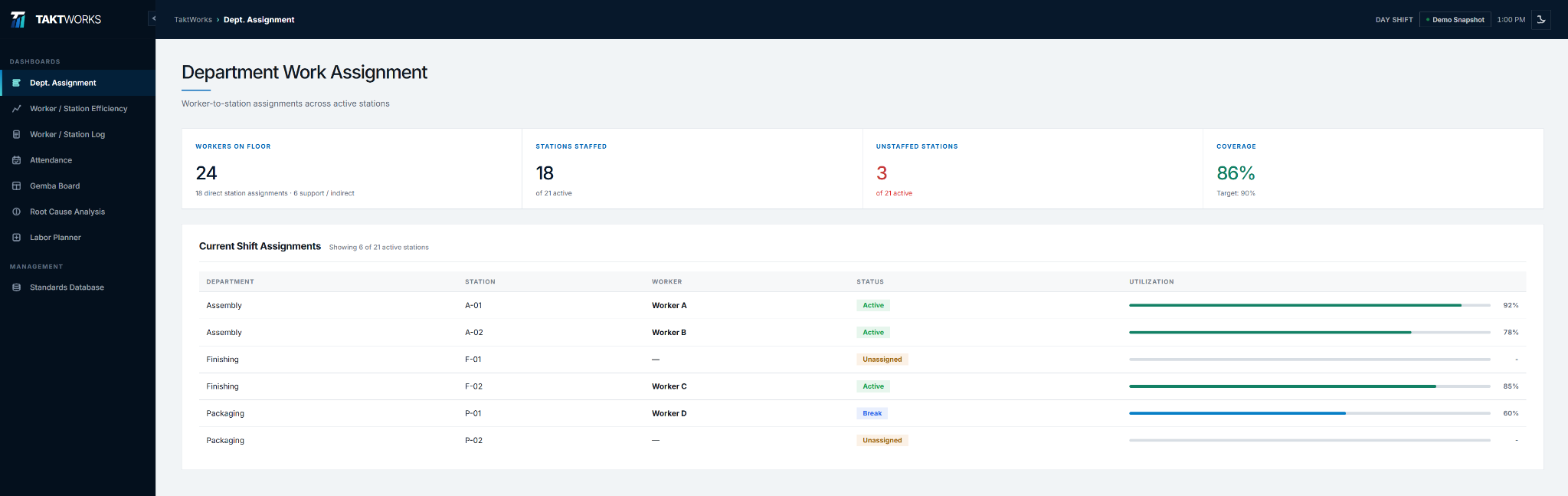
Built for supervisors, not IT departments. Every screen is designed to shift your team from reactive firefighting to proactive floor intelligence, catching problems before they hit production.

Reactive management

Supervisors chase updates, discover problems after output drops, manage by exception after the fact

Proactive floor intelligence

Real-time visibility across every station, scrap trends surface before they spike, root causes identified before they compound

Dept. Assignment W/S Efficiency Worker Log Labor Planner Gemba Board Standards DB Root Cause Analysis

Real-time station management across every active job on the floor. Current job, next job, and queue visible at a glance, with drag-and-drop sequencing, progress tracking, and one-click reassignment.

Full platform demo available on request. Book a diagnostic call to see it running on a live floor.

Quality intelligence, not just production tracking

TaktWorks turns daily worker logging into root-cause visibility, helping supervisors detect defect patterns before they compound into larger production problems.

Separate workmanship, process, and tooling problems

The RCA module connects part numbers, workers, stations, scrap quantities, and time windows so leaders can see whether quality issues are isolated to one person, repeated across multiple workers, or concentrated around a specific station, fixture, tool, or process condition.

That means supervisors can coach, reassign, refine standard work, or inspect tooling based on data instead of guessing after the damage is already done.

01

Workmanship lens

Scrap by worker, part, and time period to identify training, fatigue, skill mismatch, or reassignment needs.

02

Process lens

High scrap across multiple workers on the same part points to process, standard work, material, or design issues.

03

Fixture / tooling lens

Scrap concentrated by station or fixture helps flag tooling wear, setup problems, calibration issues, or redesign needs.

First production deployment

What a full deployment looks like in practice

Comprehensive lean + digital deployment run in 2025 ·  Currently active in production

Before

  • Floor status scattered across manual systems
  • No real‑time visibility
  • Manual tracking on whiteboards
  • Supervisors chasing updates all day

After

  • Integrated production operating layer
  • Real‑time tracking across the floor
  • Autonomous shift execution
  • Supervisors managing by exception
30 min Supervisor onboarding To full system competency
10.5 hr Autonomous weekend shift Run on the platform alone
8 Modules deployed Integrated modules in production
0 IT staff required To deploy and maintain

Supervisors moved from chasing updates on whiteboards to managing by exception, running weekend shifts autonomously on the platform.

What drove the results:

  • Layout & flow redesign: Packing area and station sequence restructured to eliminate backtracking and bottlenecks
  • Visual management: Floor zones, signal boards, and real-time status displays installed across the department
  • Standard work: Documented procedures replaced tribal knowledge, enabling consistent output across shifts
  • Digital layer on top: Supervisor dashboard and worker logging system made every gain visible and trackable
  • Single-session training: Supervisor learned the full system in under 30 minutes and ran a 10.5-hour weekend shift alone

Simple pricing for real factories

Every engagement starts with a diagnostic call. Pricing scales with factory size, number of departments, platform modules, and the level of ongoing advisory support required.

Tier 1

Starter Diagnostic

$1,500 / one-time

A focused current-state assessment with clear priorities and a path forward.

Includes

  • Virtual or on-site walkthrough
  • Flow, layout, and visual system review
  • Findings + recommendations summary
  • Starter KPI pack for your floor

Platform access

Dept. Assignment W/S Log System W/S Efficiency Labor Planner Attendance Gemba Board Standards DB Root Cause Analysis

No platform included at this tier

Book diagnostic
Tier 2

Floor Transformation

From $10,000 / project

Physical lean engagement for one pilot area. A floor that runs better from day one.

Includes

  • Layout & flow redesign
  • Physical visual controls, signal boards & floor markings
  • Workstation & material flow optimization
  • Standard work documentation
  • 5S implementation

Platform access

Dept. Assignment W/S Log System W/S Efficiency Labor Planner Attendance Gemba Board Standards DB Root Cause Analysis

No platform included at this tier

Book diagnostic
Tier 4

Custom MES‑lite — Single Department

From $30,000 + $4,500/mo per department

A fully configured execution system built around one department, with custom dashboards, standards, and improvement cadence.

Includes everything in Tier 3, plus

  • Full platform configured to your department
  • Custom KPI architecture & reporting
  • Attendance & workforce tracking
  • Gemba Board & standards database
  • Multi‑shift support
  • Root cause analysis: scrap by worker, part number, and fixture
  • Workmanship vs. process vs. tooling diagnosis

Platform access

Dept. Assignment W/S Log System W/S Efficiency Labor Planner Attendance Gemba Board Standards DB Root Cause Analysis

All modules unlocked for one department

Book diagnostic
Tier 5

Enterprise Roll‑out

From $75,000 + $7,500/mo for the first two departments

A multi‑department deployment with cross‑department dashboards, consolidated reporting, and coordinated improvement cadence. Implementation scales at +$15,000 per additional department, and monthly support adds +$2,000 per additional department.

Includes everything in Tier 4, plus

  • Cross‑department KPI governance and leadership reporting
  • Multi‑department material flow & labour coordination
  • Enterprise rollout & program management
  • Consolidated dashboards & multi‑site support

Platform access

Dept. Assignment W/S Log System W/S Efficiency Labor Planner Attendance Gemba Board Standards DB Root Cause Analysis

All modules unlocked across departments

Typical engagement range: $80K–$150K depending on number of departments and scope

Book diagnostic

Ongoing support scales with how much help you want after go-live

Keep the entry point approachable, but choose the right monthly cadence for the level of support your operation needs.

Platform Support

From $1,500/mo
Hosting, bug fixes, light dashboard updates, user support, and basic system maintenance.

KPI Review & Coaching

From $3,500/mo
Monthly KPI review, dashboard refinement, improvement recommendations, and supervisor coaching — included in Tier 3.

MES‑lite Optimization

From $4,500/mo
Full platform support, RCA trend review, multi-module refinement, and leadership reporting included.

CI Partner

From $7,500/mo
Weekly operating cadence, supervisor coaching, multi-department governance, and executive reporting.

Traditional MES $375K – $1.2M 18 to 24 month deployment
vs.
TaktWorks Custom MES-lite From $30,000 6 to 8 week pilot deployment

Pricing scales with factory size, number of departments, users, modules, integrations, and advisory cadence. The goal is a clear return on investment within months, not years.

Built by someone who actually runs a shop floor

TaktWorks was created by a manufacturing engineer and production supervisor who got tired of watching great supervisors waste hours every day chasing updates on whiteboards and spreadsheets.

I've managed production departments, run kaizen events, redesigned floor layouts, and spent more time than I'd like manually calculating efficiency numbers that should have been live on a screen. The tools that existed were either built for fully automated plants with six-figure budgets, or too generic to mean anything on a real floor.

So I built TaktWorks from scratch. I physically restructured a live production department, layered real-time dashboards on top, and validated it shift by shift until supervisors could run it autonomously. The results speak for themselves.

My goal is simple: give ops managers the same structured methodology and real-time visibility that big plants take for granted, without the enterprise price tag or the 18-month implementation.

— Alexander Cuaping
Manufacturing Engineer & Production Supervisor
BS Industrial Engineering, Texas Tech University
Founder, TaktWorks
Full stack Physical lean work and digital systems, one partner
$0 Capital expenditure to deploy the pilot
In production Running daily in a live manufacturing environment

Ready to fix your floor?

Tell me about your factory and your biggest constraint. I'll map TaktWorks to your current state and show you exactly what a pilot engagement would look like.

Book a free 30-min floor diagnostic call

Not ready to fill out a form? Pick a time that works for you. No commitment, just a conversation about your biggest constraint.

Schedule a call
or send a message